
Full transcript
00:00Pawcast Begins
Puppy JayPlot twist: my famous brother, Doxie Din, lost almost all his teeth and somehow became the happiest 15-year-old dachshund alive! My name is Puppy Jay, and welcome to the first episode of my Pawcast. My guest is the vet dentist who literally saved Doxie Din, and today she’ll tell you how to keep your dog from suffering tooth pain. Hello, Tatiana.
Tatiana KuznetsovaHello!
00:30Vet Origin Story
Puppy JayFirst — how did you even get into veterinary medicine? Did you want to be a vet as a kid? Is it because we… are way cuter than humans?
Tatiana KuznetsovaWell when I was a child, I was into equestrian sports and wanted to treat horses, but when I went to study at the veterinary academy, I realized that my fate is with cats and dogs.
00:55Exotic Patients
Puppy JaySo you dreamed of treating exotic animals, right? Did you get to treat any of them? Like tigers, dolphins?
Tatiana KuznetsovaI’ve only treated the small exotic ones a ferret and a fox. I could treat Tigers, in theory. Wolves too. Any large animals, really. I just… haven’t had the chance yet.
Puppy JaySo… you’ve never seen a shark in braces?
Tatiana KuznetsovaOf course not!
Puppy JayToo bad...
01:25Why Dentistry
Puppy JayWhy dentistry specifically? Vet medicine is so broad — Ears, paws, tail! Why did you choose teeth?
Tatiana KuznetsovaIt just happened that I tried out different things, then by chance I ended up working with a dentist, and I really liked it — it’s a very interesting specialty.
Puppy JayOkay!
01:49Loves & Hates
Puppy JayTell me — what do you like most about your job? And what annoys you? Like, I love my job! But it drives me crazy when my reward is half a treat instead of a whole one!
Tatiana KuznetsovaI love it when my patients get better and there are no complications during surgery or after it. I hate it when owners don’t listen to me and ignore my recommendations — that really pisses me off!
Puppy JayStill, we’re way cuter than humans, right?
Tatiana KuznetsovaOne hundred percent... certain!
Puppy JayWell… I think we’ve gotten to know each other a bit!
02:30Din’s Case
Puppy JayAnd you’re really not as scary as Din told me! So let’s talk about his case in more detail: At the time of surgery, Din was almost 15 years! We live in Montenegro, a small country in southern Europe, and there was simply no veterinary dentist here! And teeth are delicate...
Especially when you’re an older superdog with a global name! So after a few online consults, Din flew to you for treatment. Do you remember what exactly he came to you with?
03:03Nasal Symptoms
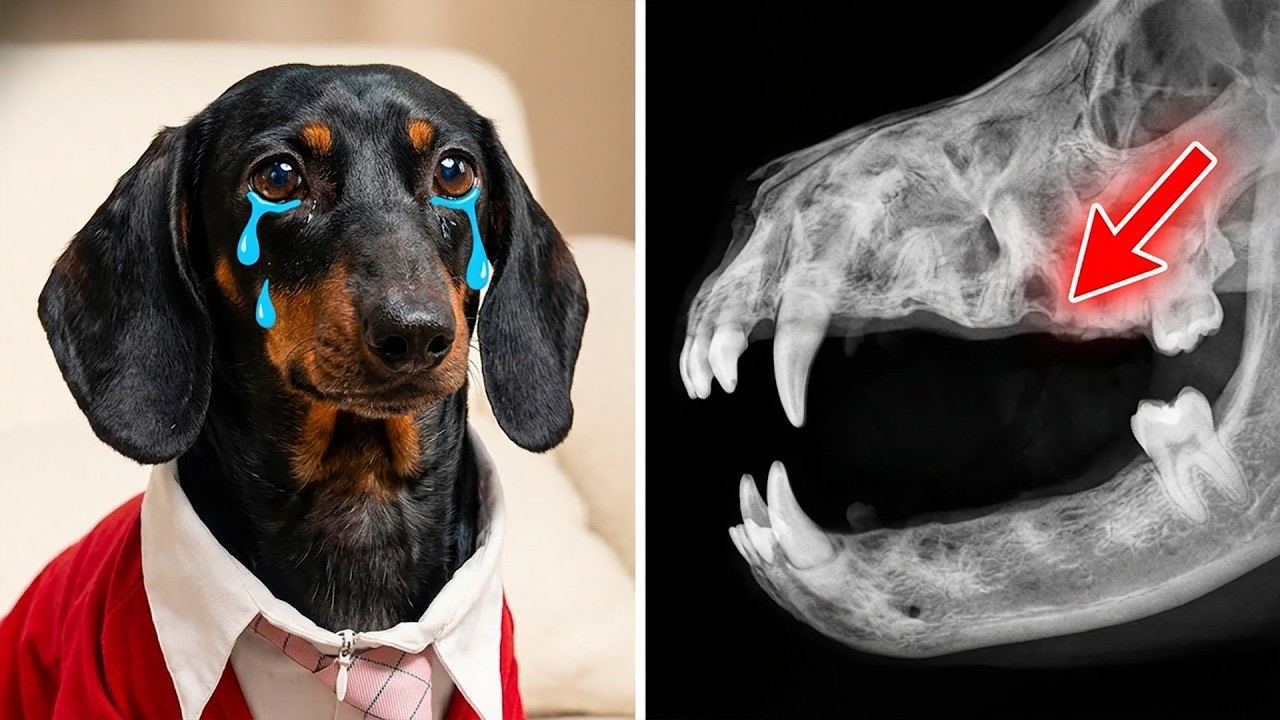
Tatiana KuznetsovaI remember he came in with intermittent sneezing, and there was pus coming from his nose — not all the time, but it would show up in episodes. So this is a common issue in dachshunds, and it’s treated surgically. First we have to confirm that the problem really is caused by the teeth, and then we remove them — in other words, that’s how we treat it.
03:26Teeth to Nose
Puppy JayTell me — how often does it happen that dental inflammation spreads into the nose? Does this happen to all dogs? Or is it especially common in dachshunds?
Tatiana KuznetsovaYes, this is a very common and frequently encountered dental problem. It primarily affects small or medium-sized dog breeds, especially those who have longer muzzles. In that area there isn’t much bone to begin with, so the inflammation spreads very quickly. It doesn’t have to destroy a lot of tissue before it reaches and eats away the bone.
Basically there just isn’t enough bone volume in that area, so the inflammation tends to progress much faster than it would in a big dog with a massive jaw and denser bone tissue. So yes, we mostly see this in toy and small breeds, and in those narrow-jawed dogs as well.
Puppy JayWhen Din got a CT scan, we saw there was very little bone there — and it looked like it wasn’t a dog’s nose, but some pterodactyl’s! Is that what you mean?
Tatiana KuznetsovaThat's correct... Yes... So basically it’s just one of the factors that can actually predispose them to this disease.
Puppy JayBefore Din came to you, our parents did a whole tooth photo shoot, and sent you all the pictures! So I’m curious — did you already see then it was the canines? Or is that impossible from photos, and it only became clear after CT or an in-person exam? How does diagnosis usually work — what’s obvious, and what's not?
Tatiana KuznetsovaWith some patients you can see that right away in your dog’s case I really didn’t like the areas on the inside of the teeth, right where the canines go up into the palate. So not on the outside, but exactly on the inside. And there, deep down, there were massive tartar deposits which, from experience, already tell me and hint that there are quite deep pockets hiding in there.
So I first suspected this problem from the photos your parents sent me, but I could only confirm the diagnosis after we ran the CT scans and then, during surgery, using instruments and X-ray images. So the diagnosis was finally fully and properly confirmed, of course, once we had all of those additional tests done.
05:5312 Teeth Removed
Puppy JayDuring the surgery you removed 12 teeth from my brother Doxie Din — is that considered a lot, or pretty normal? Especially since it was all in one procedure!
Tatiana KuznetsovaIt’s all very individual, because every patient every dog reacts differently to trauma, reacts differently to pain, and of course - the tooth damage is different in every case. We focus on how much trauma we’re creating, on the overall scope of the surgery we’re planning.
In fact, twelve teeth is neither a lot nor a little — it’s, well, a pretty normal clinical number. Well. Sadly, or luckily, I don't know. Overall, we sometimes remove all teeth at once if they're in bad shape. So sometimes it's even better to remove all teeth, all forty-two, or a bit less, if your pet simply has fewer teeth.
It’s still better than leaving a big source of infection, especially when the case is very neglected. In Din's case it wasn’t that advanced, and some of the teeth had already been removed before, so twelve teeth is kind of an average number that’s absolutely acceptable to do in one visit.
07:06Leftover Roots
Puppy JayDin had another issue — he had leftover tooth roots in his jaw, from teeth removed earlier, at different clinics...
Tatiana KuznetsovaYes.
Puppy JayAm I right that this happened because we went not to dentists, but just to general-practice surgeons? And for them, this kind of “partial” extraction is normal?
Tatiana KuznetsovaI can't be responsible for other doctors' actions. Perhaps it's a lack of knowledge, a lack of equipment, right? So, it's possible they don't have X-ray images and perform extractions blindly, not knowing, for instance, if a tooth is fractured, or if the tooth possesses a particular anatomical form.
For example, sometimes dental anomalies are encountered: three roots instead of two, or two instead of just one, and so forth. Very often a doctor simply doesn't realize what they're doing, and sometimes doesn't even intend to harm the patient. But they do cause harm because they don't have X-ray images or specific experience readily available.
Puppy JaySo, in simple terms — for dental treatment you really should go to a vet dentist, right?
Tatiana KuznetsovaYes, if there's such a possibility, of course, always go to dentists. Because, firstly, they possess quite extensive experience in extracting teeth, especially complex ones. They’ve got a practiced hand, their speed is beyond regular surgeons. So, the surgical technique is already, so to speak, established in a specific order, and all vet dentists, good vet dentists, always take X-rays before and after tooth extraction to ensure the quality of their surgical procedures, and so that you can be confident that you truly paid for quality work.
Puppy JayBy the way, this surprised me — Din had two upper canines removed!
Tatiana KuznetsovaYes.
08:52Canine Extraction
Puppy JayAnd honestly, I can’t imagine how you can even pull them out — they were huge, powerful… Seriously — do you need a gym membership to handle teeth like that?
Tatiana KuznetsovaWhen extracting any tooth, force is not whats needed, technique is what truly matters. There are specific techniques we follow during tooth extraction, and we generally do not need to use any extra force at all. Yes, if we were to extract a tooth from say a bear, then naturally force would certainly be necessary.
But we're dealing with small patients, so the technique is what truly matters. That's why we sometimes encounter situations where surgeons break jaws because they resort to force, and that's something you simply cannot do. The jaw is a small bone, tiny and delicate.
So, technique is extremely important here.
09:45Pre-Op Checks
Puppy JayAt first, Din was going to be treated in Serbia, at a dental clinic. But they probably played it safe and refused to see him — because his bloodwork showed not-so-great biochemistry. Obviously that matters so anesthesia is safe! So please tell us — what does pre-op preparation usually look like?
Tatiana KuznetsovaOf course, it's absolutely essential to examine every single animal. It's not just about older animals; even the very youngest can be patients whom, for various reasons, we might not be able to clear for surgery. It's absolutely necessary to perform blood tests and conduct a thorough heart examination.
And if something in the patient's medical history concerns us, we can send them for an abdominal ultrasound, to look for structural changes in their internal organs. If there are any abnormalities, then we need to understand why they occurred, and if it's dangerous during and after anesthesia.
Accordingly, we anticipate the outcome of our surgery, based on our diagnosis, on our diagnostic findings. Therefore, it's very important for the anesthesiologist to receive a full list of all chronic conditions. It's vital for me to get this, in order to prescribe proper therapy after the surgery, and to prevent any complications.
Accordingly, the anesthesiologist also checks for heart, kidney, or liver issues. Because blood pressure, that is, the depth of sleep, is determined, and this is very important during anesthesia. As far as I recall, Din didn't have any critical diagnoses that would require treat, that would make anesthesia impossible.
There are certain deviations, but these are absolutely controlled by the anesthesiologist, considering our current modern capabilities. So, anesthesia is chosen individually, dosages are individually selected. The time frames also, they may depend on chronic conditions and how well your pet sleeps.
Therefore... So... yes, diagnosis is vital and needed.
Puppy JayOkay, let’s consider this case:
11:59When Anesthesia Risks
Puppy JayWhat if a dog can’t have anesthesia? Like heart problems... But the teeth are in bad shape? So in that situation, treatment is impossible? And the dog just has to live with pain?
Tatiana KuznetsovaWhat does 'heart disease' truly mean? There are specific diagnoses, and there are specific stages of the illness. And truly, for some stages of the condition, the risk of anesthesia is quite high. However, with such diseases, the pet usually doesn't have much time left to live.
Or we understand the risks and that life, which, uh, essentially, is not of very good quality, with constant pain and suffering, which can significantly worsen the overall quality of life. Sometimes owners decide to take this risk, knowing that their pet might, you know, not wake up, but at least it will have a chance at a comfortable life.
But if we see that there really is a serious dental condition in the mouth that needs urgent treatment, for example, if everything is decaying in the oral cavity, the infection is spreading throughout the internal body. So there are such cases. And if there are existing heart conditions, cardiologists typically prescribe a course of therapy, which means preparing the patient for anesthesia.
So the patient, for about one to two weeks, takes specific cardiac medications, and then proceeds with the procedure with the lowest possible risks. Yes, these risks are still considerable, but we do manage to reduce them. But in most cases the animal is cleared for dental treatment.
I haven’t had a case in my practice where I had to completely refuse it.
Puppy JayThank you for explaining, because that’s one of the biggest fears for owners!
Tatiana KuznetsovaYes, it's true.
Puppy JayAnesthesia sounds scary, especially for an older dog!
Tatiana KuznetsovaIt's not without reason, because there are indeed different cases, different outcomes, but the most important thing is the right approach. To minimize risks, whenever possible, and be very honest with the owner, explaining that various outcomes are quite possible.
If the owners are prepared for that, then we are ready to provide assistance.
Puppy JayIf Din hadn’t come and kept living with inflamed roots — how could that end?
14:16If Untreated
Puppy JayWhat would happen without treatment?
Tatiana KuznetsovaOverall, he might have continued sneezing for a very long time, and perhaps nothing critical would have happened to his condition. But perhaps it all worsened to the point where he couldn't stop sneezing, he would have sneezed day and night, he couldn't breathe anymore.
This severe inflammation would be present in the nasal cavity, and consequently, when he sneezes and inhales these bacterial, exudates, he poisons his entire body. It also negatively affects the kidneys, the liver, and the heart. And, consequently, bacteria can circulate from the oral cavity, from the nasal cavity throughout the entire body.
15:09Life Without Teeth
Puppy JayTell me, Din has almost no teeth left... Is that a tragedy? Or can you live just fine with that set?
Tatiana KuznetsovaOf course, you can live with this. Cats and dogs, especially if they're living in a domestic setting, they don't have to hunt for their own food; owners provide it for them, and so all they have to do is simply swallow and use their little teeth as intended— the ones that don't hurt.
Because, mostly, in the wild, yes, they would certainly need to forage for food. And their lifespan in the wild is extremely short, only about five to seven years. If their teeth break in the wild, then naturally, they can't hunt for food and they can't feed themselves, and they become easy prey for other predators.
If we're talking about a home environment, for many animals, teeth aren't necessary for a comfortable home life. This doesn't mean we indiscriminately remove teeth from all pets, but if there's an indication, if it's necessary, it must be done. If their teeth are healthy, that's great!
Puppy JayYes, you said Din has 6 teeth left, but we’ve only found 4 so far... but he’s doing great — he even bites harder now!
Tatiana KuznetsovaYes... They're somewhere deep there!
Puppy JaySo he has 4, or maybe 6 teeth... Do we still need to care for them somehow?
16:28Periodontitis Basics
Tatiana KuznetsovaYes, because periodontitis is the diagnosis that made Din lose his teeth, our treatment can put it into remission, but it doesn’t “go away” And even the teeth we leave because they look healthy can still become inflamed over time. To postpone this for as long as possible, we recommend brushing your teeth, because the main trigger for periodontitis is primarily dental plaque and tartar.
These are bacteria that naturally accumulate every single day. And therefore, to help us preserve your remaining teeth, we strongly recommend brushing them regularly.
Puppy JayOkay, Din started brushing daily at about age 5, if he had started earlier, could he have kept all his teeth? Or by 15 it’s almost impossible anyway, even with perfect care?
Tatiana KuznetsovaNo, there are cases when even at fifteen years old, teeth are perfect, and we don't remove anything. That's actually a rarity, but it does happen. We don't know what would have happened if we had started earlier... Maybe it didn't affect anything, or maybe it did...
Unfortunately, I don't know... How it would be.
Puppy JayAfter everything that happened to Din,
17:41Best Home Care
Puppy JayI — Puppy Jay — decided to keep all my teeth into old age! Every one! I need the most ultimate care — what’s included?
Tatiana KuznetsovaThe very best thing is to brush your teeth every single day with high-quality brushes and toothpastes, trying not to miss a single time, and providing some gentle load on your teeth. This means some kind of toys or regular exercise should be present in the oral cavity, and you should periodically visit dentists.
That is, you should definitely visit a dentist once a year for a thorough examination. If the dentist observes perhaps that some dental calculus is already beginning to form and maybe there's a slight insignificant redness of the gums, then professional dental hygiene should be performed under anaesthesia.
Puppy JayAnd without that passion, what’s the minimum? Is it just daily brushing?
Tatiana KuznetsovaYeah, based.
Puppy JayOkay, you mentioned a good toothbrush is important!
18:40Choosing a Brush
Puppy JayWhat exactly counts as a good toothbrush for a dog? What should we look for? Shape, bristles, size? What really works?
Tatiana KuznetsovaIt’s basically the same as a good human toothbrush. In general, most veterinary brushes are quite hard and aggressive. They can scratch teeth, scratch enamel, scratch gums, and thereby may even cause harm over time to the oral tissues. We should choose a soft toothbrush with an even cut and plenty of bristles, so that it’s comfortable to use and the brushing process itself feels comfortable.
We use circular motions or parallel strokes while brushing. You can also brush from the inside, if the pet allows it. And, well, mainly, if we’re talking about the brush, yes, it should be soft, with an even cut, and, uh, As the bristles start to fluff out and lose their shape, we need to replace the brush.
19:46Electric Toothbrush
Puppy JayMy daddy has a super fancy ultrasonic toothbrush! With tons of modes, lights — everything flashes! Can I use that, or is it just for humans?
Tatiana KuznetsovaYes, of course! Ultrasonic toothbrushes can be used for animals. The most important thing is not to use excessive force. There should be no strong mechanical irritation on the gums, and the dog should not be afraid of it. Because of the different modes: buzzing, vibration - it can scare.
Puppy JayIs it actually more effective than regular brushing? What do studies say?
Tatiana KuznetsovaNo such research for animals...
Puppy JaySeriously?
Tatiana KuznetsovaYes, there is no research comparing cleanings with a regular brush and specifically with an electric one. Unfortunately, yes, there are no such studies, but there are studies that show the ineffectiveness of silicone brushes. That is, silicone finger brushes, silicone brushes — they are not effective.
Puppy JayAh, so you mean those finger brushes, the ones usually for kids, right?
Tatiana KuznetsovaYes...
Puppy JayI remember when I was a puppy, my parents used one for a while — when I was just getting used to brushing!
Tatiana KuznetsovaDuring the initial training period, this is acceptable. When they’re just puppies, why not? But later on, if we’re talking about real preventive dental care, it’s not effective.
Puppy JayWhat about cloth finger brushes? Are those useless too?
Tatiana KuznetsovaNo, the cloth finger brushes are now more or less okay. Not so bad... They can be effective.... It depends here on how much we reach all the teeth with a finger... uh... Can we actually reach all the area...
Puppy JaySo, at what age should you even start brushing teeth?
21:30Start Brushing Age
Puppy JayIf I still have baby teeth, do I need to brush them already? Or can I just watch hygiene TikToks and pretend I’m on it?
Tatiana KuznetsovaYou can start getting your pet used to brushing their teeth at this age, so they understand that having their mouth touched is normal. In general, it is ideal to start brushing teeth from five to six months, as permanent teeth begin to appear, and accordingly, we can begin hygiene at this time period.
You can do it later, but why not do it earlier?
Puppy JayI started caring about dental health from early puppyhood! At first I just stole Din’s toothpaste caps — I loved the taste! But back then I still had baby teeth... And as soon as I was allowed to brush — I was so happy! Like I got into a private club! I had my brother Din as an example, and I always wanted to brush teeth just like him!
My parents didn’t have to convince me at all! But not everyone is like that... How do dogs get used to brushing? Can you make it, like… fun? Or at least not scary?
Tatiana KuznetsovaIt's essential, to encourage, positively reinforce, give a treat, or engage in play during the training period, so that there are positive vibes from this entire process. But if your pet is acting aggressively, then unfortunately, we cannot give any recommendations, other than visiting a dog trainer, right?
Or an animal behaviorist. Because there's a specific problem here, one that we don't know, and it needs to be thoroughly investigated. If the puppy is active, cheerful, and energetic, then it is easily trained over time. No one trains it in a week - it is quite a long process.
At first we just touched the tooth, just held a finger on the tooth for a moment… waited a little, praised warmly. The next day, we touched teeth, extended the time a little more, praised them, played, and gave them a treat. Then, with the brush, one tooth, two teeth, three...
And we always increase the intensity of our training.
Puppy JayGreat advice! But if your puppies aren’t as obedient as me — and brushing training feels like pure fantasy… …then I’ve got something cool for you! It’s my favorite guide “Secrets to Successfully Raising a Puppy ”,
24:02Puppy Guide Plug
Puppy Jaymade by my parents and famous brother Doxie Din — It’s packed with everything they learned while raising the two of us — me and the legend himself. 🐾 The guide has a whole chapter about hygiene and teeth — and even a video add-on with a step-by-step brushing method!
This guide will help you raise not just a dog, but a legend with dream teeth! The English version is available via the link in the description, and for my Patreon subscribers — the guide is free starting from a certain tier! I grew up on this guide! And look at me — handsome, smart, and teeth are fine!
Don’t miss it! Okay, dental care is super important, I don’t think anyone will deny that!
24:57No Brushing Consequences
Puppy JayBut what if you never brush teeth at all! At what age do dogs usually start losing them? On average... Like… if you totally ignore it!
Tatiana KuznetsovaThe absolute maximum I've personally encountered was a year and a half. We removed all the dog's teeth at that age.
Puppy JayA year and a half?! So… you barely chewed toys — and you’re already toothless?
Tatiana KuznetsovaYes.
Puppy JayThat’s horrible! But let’s figure out why teeth go bad in the first place!
25:26Cavities Are Rare
Puppy JayI recently saw a TikTok saying the most common human tooth problem is cavities... But dogs almost never get cavities, right... Why is that? Do we have super enamel?
Tatiana KuznetsovaAmong the entire dog population, dental decay is observed in approximately five percent of cases. This is considered an extremely rare occurrence. Indeed, it is mostly humans who are more susceptible to this condition. First of all, cats absolutely do not have a single case of dental decay.
It simply does not occur in them. We can only observe it in dogs, and then only in five percent of cases. If I consider my statistics, I probably detect tooth decay in one or two patients a year and we treat it. Why does this happen? Why is tooth decay so rare in dogs - first, it’s their anatomy.
In animals, they have the correct spacing between their teeth, they are spaced correctly from each other, meaning there are interdental spaces. The contact points are far enough apart if we are talking about correct anatomy. Teeth are not as crowded as ours. They don't have chewing surfaces mostly throughout the mouth.
Their teeth are sharp, only the very last teeth have flatter surfaces. And naturally, the food and pH differ — the pH is much higher in dogs, and truly low-carbohydrate food which does not contribute to cavities is not very common. If a dog has certain health issues, for example endocrine problems, then we might sometimes find cavities on the very, very back teeth.
During a routine examination they are almost never visible; they’re usually accidental findings during a professional cleaning.
Puppy JaySo if it’s not cavities, what makes dogs’ teeth go bad then?
Tatiana KuznetsovaThey have other diagnoses – it's called periodontopathy, periodontitis.
27:24Periodontitis Explained
Tatiana KuznetsovaThat is, when there are already problems with structural changes in the bone tissue, meaning the bone no longer holds the tooth in the socket. For some reason, usually due to significant tartar, gum inflammation, bacteria penetrate beneath the gums and start to destroy, to eat away at this bone.
And the tooth begins to loosen or fall out, because it's already been eaten by bacteria. That's why it's so important to brush their teeth, to prevent tartar from forming where it meets the gum, so no bacteria can penetrate. This is why periodontitis is predominantly found in dogs.
Puppy JayOkay, thought experiment -
28:08Age by Teeth?
Puppy JayA dog comes in, you’ve never seen them before, but you open their mouth and… Can you guess how old they are?
Tatiana KuznetsovaThat's an interesting question. In fact, the condition of your teeth... it depends on many different factors. Visually, we cannot even determine the age, simply by looking into the oral cavity, because, as has already been mentioned, at one and a half years old, all the teeth might need to be extracted, they can become severely inflamed for various different reasons.
Therefore, we might falsely assume that the dog is old, but in reality, it is young. Or, conversely, if the genetics are good, or the owner took very good care of them, at ten years old, they can have excellent teeth, and we might think, "Wow, these teeth look like they're only two or three years old" Therefore, visually, it's a very inaccurate assessment, and we cannot determine age based on visual appearance.
29:06Brushing Duration
Puppy JayTell me, how long should a tooth brushing session last? Is it like — one-two, and done? Or do you really have to… work?
Tatiana KuznetsovaWell, it really depends on the specific pet and the type of cleaning. If your pet calmly allows you to do absolutely everything, cleaning both the inner and outer surfaces, some need less than a minute to thoroughly clean their teeth, while for others, it takes about five minutes.
That is perfectly normal. It's quite different for everyone. Some dogs will literally only give you a few seconds. Then you'll have to take a break, then you'll need to clean something else again, then another break. So everything is very individual and depends entirely on the specific pet.
Puppy JaySo even minimal hygiene is still better than none at all?
Tatiana KuznetsovaYeah... Yes.
Puppy JayThen many will say — “Why brush if I give my dog a bully stick or special treats?” They “clean” too...
30:01Chews Aren’t Enough
Puppy JayIsn’t that a strong argument?
Tatiana KuznetsovaThat's not a very strong argument. It's a good supplement to regular tooth brushing. However, if we rely solely on chewing, it's important to realize that this mechanical stress only impacts a specific segment of the teeth. I mean, a dog has forty-two teeth specifically: canines, incisors, premolars, and molars.
But probably, only about fifteen of the forty-two teeth are actually involved. Therefore, it's false to hope that all forty-two teeth will be cleaned just from some kind of mechanical tension or mechanical pressure – that's simply wrong. Uh, but as a complement to regular brushing, offering some hard chews, long-lasting treats.
I'm always in favor of that. But for those who rely solely on chews, only certain teeth can self-clean, and definitely not all of them. For example, the canines and incisors, they don't participate in this process at all. If we look at how a dog chews, you'll see it chews on one side, and on the other side only with its back teeth.
Puppy JayTell me, are there harmful treats?
31:08Dangerous Chews
Puppy JayWhat’s on a dentist’s blacklist?
Tatiana KuznetsovaThere are! in fact there are many... The first one is a reindeer's antler. It’s a very aggressive chew and very hard, and if a small dog has problems with overexcitement, they may not control the strength of their bite, get too excited, and just break their back teeth like that.
Even a bully stick, if it’s over-dried or if a dog gets really overexcited about this kind of treat, can in the end just break their teeth as well. So you need to look specifically at the character, how the pet gnaws, whether there are psychological issues like overexcitement, or work on it with a dog trainer and then give hard chew toys to avoid such a strong mechanical load...
Alternatively, we exclude such hard treats forever that could break teeth. These are stones, sticks, horns, plastic bottles, some twigs and branches - all of this can cause damage to the oral mucosa and the teeth.
Puppy JayAnd if a dog can’t have treats — like allergies…
32:22Toys as Dental Care
Puppy JayDo the toys they play with count as some kind of load on the teeth? Is there any benefit?
Tatiana KuznetsovaYes, a toy can be useful, because it provides mechanical stress on the tooth ligaments and, accordingly, can beneficially affect both self-cleaning and the tooth itself.
Puppy JayNext time I’ll say this straight to my parents: "I need new toys. It’s not for fun… It’s for my teeth!" Because play is hygiene too! Okay, what about dry food?
32:55Dry Food Myth
Puppy JayThere’s this opinion that it helps clean teeth... You just eat — and your teeth get cleaner! Sounds nice and tasty. But is it actually true?
Tatiana KuznetsovaThere are certain studies that comparing... different diets, such as dry, wet, and natural. But what we need to understand is that every single pet has its own unique eating habits. If, for instance, we were to ask, let's say, ten different dogs how each one eats, we would get a variety of responses.
Some dogs devour their dry kibble, literally inhaling it in just a second. We can even observe that their teeth barely engage, they don't even need to chew. Someone will eat that very same food with care, slowly breaking down piece, providing a good exercise for their teeth.
And, naturally, these two dogs will already experience different effects on their teeth. Meaning, for some, their teeth might genuinely self-clean, while for others, absolutely not. However, if we're discussing a soft diet, a soft diet tends to coat the teeth much more.
Mechanical cleaning does not happen at all, and of course, more dental plaque and tartar are formed. It doesn't matter if it's natural food, pâtés, pouches, or soaked food; the consistency is what matters!
Puppy JayGot it… I’m the type who just swallows kibble! So no extra portion for me... Back to theory! Am I right that the scariest part is when tartar starts touching the gums?
Tatiana KuznetsovaYes, they contact the gums and the gums are like, 'What am I supposed to do? I'm already getting sick from these bacteria! Help me! ' That's when, yes, we really must resort to professional cleaning.
Puppy JayHere’s something nteresting:
34:52Water Additives Myth
Puppy Jaythere are special liquids you add to water — and they promise less plaque? Does that really work? Or does it only sound good on the label again?
Tatiana KuznetsovaThis is just a marketing - It would be absolutely wonderful if they actually worked. But there are no proven sources. No scientific studies confirm that anything truly works.
Puppy JayTartar is the main enemy of healthy teeth in dogs! A real supervillain! So what — there truly is no magic remedy? You smear it on — and tartar vanishes. Victory!
Tatiana KuznetsovaYes, that would be great for people too! We would use it ourselves as well, if it were really suitable for animals. But unfortunately, they haven’t invented anything like that yet. And if they say it completely dissolves all the dental plaque, just imagine what it could do to the oral mucosa.
So if there's some kind of thermonuclear mass that can dissolve stone, then what about the mucous membrane and the tooth itself? That's not good.
Puppy JayToday we’ve caught corporations a few times on… exaggerated claims — when it comes to pet care products. But you know what we haven’t discussed yet? Toothpastes!
36:09Toothpaste Dangers
Puppy JayAre they all the same? Or is there a difference?
Tatiana KuznetsovaNo, they’re not all the same; the formulations can differ, and unfortunately some of them can even be dangerous. Many toothpastes contain fluoride and xylitol. So people who have nothing to do with veterinary medicine go into the pet business and start producing toothpastes that are basically the same as human ones.
But they really shouldn’t do that, because xylitol and fluoride, which are used in human toothpastes, are toxic for animals. So it’s very important to check the ingredients carefully, so we don’t end up harming our pets. Yes, if we've given only minimal, insignificant amounts, nothing will happen.
But if we consistently give toothpaste with xylitol or fluoride, we could face complications. So, all toothpastes are different; you need to check the ingredients. And actually, there are also enzymatic pastes that can potentially complicate the progression of gastrointestinal pathologies.
For instance, if a dog has enteropathy, or perhaps an intolerance to a specific protein, or even something else entirely then a veterinary paste flavored with chicken, liver, or beef could easily provoke a digestive upset. Therefore, if your pet has chronic problems, for example, with food-related issues, or with their GI tract, then we don't recommend using any pastes at all.
You can simply brush with a toothbrush moistened with water, so as not to aggravate or provoke the condition of their GI tract.
Puppy JaySo you can brush even without toothpaste and it won’t hurt effectiveness much?
Tatiana KuznetsovaNot significantly.
Puppy JayOh, that marketing… But… since we brought up promotion — I want to say a few words about our Patreon.
38:01Support on Patreon
Puppy JayThis Pawcast — like my show Sunday Puppy Jay — we make with a small family team. We don’t have producers, huge budgets, or brands behind us. Everything you see — we write, shoot, edit, voice, and design ourselves! There’s enough work for everyone — even Din helps out!
Even though he’s almost 16! If you like what we do — if you connect with kind, honest animal content, made with humor, love, and brains… …then you can become part of our pack. By supporting us on Patreon! It’s real support for us — and cool bonuses for you! We have different tiers and different perks: access to an active online chat with me and my parents, the ability to watch videos without ads, and even access to exclusive personal projects — short films and stage productions, made by my parents — outside my project!
For us it’s not just a platform. It’s support. Without it there’d be no Pawcast, no Sunday Puppy Jay, and honestly… no healthy teeth for Din! So if you like what we do — support us! Scan the QR code on screen, or use the link in the description! And if you’re already with us — thank you so much!
You’re the real heroes behind the scenes! Alright, back to teeth! Ok, next question.
39:39Anesthesia-Free Cleaning
Puppy JayAs I said — all owners fear anesthesia. And I get it! But now more often they offer so-called anesthesia-free cleanings — for example, in grooming salons. Sounds tempting! But how effective is it, really?
Tatiana KuznetsovaIt's inefficient because we can't clean the teeth from the inside. Especially if the dog isn't sleeping. During a regular examination we can’t properly assess the very last teeth, the ones right at the back — we simply can’t see them fully. These teeth are set very deep, and we can only really see them when the mouth is opened wide and the dog is completely relaxed.
If we’re talking about a cleaning without anesthesia, it’s simply not something you can really perform. In reality, they only do a cosmetic procedure so that the owner sees white teeth — and if the teeth look white, then in the owner’s mind that already means they’re healthy.
But this is a completely mistaken belief. So essentially, all of this doesn’t truly help the animals. However, since there is a demand from pet owners, such manipulations do indeed exist, but— regarding the quality, uh, it's really not worth talking about here.
It absolutely does not exist! No dog will ever allow anyone to perform a truly thorough cleaning, and then polish all of its own teeth. It’s simply impossible to see some of these hidden areas around the teeth and fully diagnose them. Any self-respecting dentist would refuse to do this kind of procedure — it’s simply impossible to do it properly.
Puppy JayYou mentioned polishing after ultrasonic cleaning.
Tatiana KuznetsovaYes.
41:15Why Polishing Matters
Puppy JayWhat is that, and how important is it?
Tatiana KuznetsovaYes, that's absolutely correct, because ultrasound is by no means a harmless device. It can cause damage if we don't clean properly. And the position of the scaler during cleaning is especially important. We can, and often do, cause micro-cracks on the enamel when we clean with ultrasound.
But with a high-quality cleaning process, using the proper technique, these micro-cracks and micro-grooves are then precisely polished smooth with a special brush and a paste. If this isn't done, then, naturally, these tiny micro-grooves and micro-cracks will appear.
Plaque will then accumulate there much more quickly than if we had carried out a thorough polishing. And, of course, there might even be some noticeable sensitivity for the dogs in that specific area.
Puppy JayGot it, so… ultrasound without polishing is like… a toy without a squeaker? Thanks for explaining! But let’s get back to cleaning without anesthesia.
42:13No-Anesthesia Risks
Puppy JayYou said it’s impossible to do everything truly well… But it’s also very scary, right? You’re in some weird place, strangers all around, and someone’s in your mouth… It’s not just unpleasant! It's actually frightening!
Tatiana KuznetsovaThis is not only unpleasant, it can be painful! If, say, the person doing this didn't notice, didn't suspect a bad tooth and began cleaning it with a scaler. This causes quite severe pain for the dog, which is immediately registered in the brain. Its blood pressure rises, it starts to struggle and breathe more rapidly, and its body temperature goes up even further.
And since they work in the oral cavity with this ultrasonic scaler, all the water that drains from the mouth can then very easily be accidentally inhaled by the dog. So, with this rapid breathing, the dog might swallow the remnants of dental plaque that are being scraped off.
Or sometimes, there have even been isolated cases where a tooth fell out and it entered the trachea, this can even lead to fatal outcomes. This can also cause quite severe bleeding. A strong cocktail of stress can detrimentally affect the heart, kidneys, and liver.
Consequently, many people say, 'We cannot have anesthesia, we will go and do it without it' They either proceed with the procedure without anesthesia, but they don't undergo an examination, and they don't know the state of the internal organs of their dog or their cat.
They perform this kind of harsh fixation, causing pain, stress, and anxiety. This cocktail of hormones and stress can adversely affect all internal organs, and within a week the dog may still not recover fully, potentially leading in some cases to pulmonary edema and even death.
And also, a lot of restraints are used on animals. They resist, they don’t like it, they want to get out of it, but they are swaddled and deliberately pressed, thus putting pressure on the rib cage. They can't fully breathe and release their breath. Or they might dislocate the atlas, which is the cervical spine.
Or they could cause injuries to their joints. Very frequently, the hip joint dislocates in smaller dog breeds. And subsequently, owners find themselves dealing not only with the immediate stress, but also with potential panic attacks and ongoing anxiety for their pets.
They must consult orthopedic specialists to stabilize this dislocation or even treat severe pelvic fracture. In short, many serious complications can come from this kind of procedure.
Puppy JayOh, no! I hope those extreme cases are rare... My story is totally different:
45:19Owner Reassurance
Puppy Jaymy parents — they take care of me and Din on max settings! They really do everything they can! But even with super care, we can still get some tartar somewhere, or even something more serious, like Din’s case... And they feel guilty about it… Can you say a few supportive words to them, as a specialist?
Because seriously — they’re the best! It’s just that sometimes nature beats the toothbrush.
Tatiana KuznetsovaYes, that's right. You definitely shouldn't blame yourself. And I'm against that, because if you brush daily, you're doing everything you can. In fact, we can't even clean our own teeth perfectly sometimes, and we go for professional hygiene every six or twelve months.
It's the same for animals, especially since they are not humans who can be told: 'Be patient.' That means there are places we might physically not reach and that's completely normal. Dogs have, well, a certain anatomy, fissures where more plaque and food get stuck, and a brush can hardly reach them.
So, some teeth, some yellowing in certain indentations of the tooth is absolutely normal, it's nothing to worry about. We're not saying that by brushing their teeth, we'll maintain an ideal state throughout their entire lives. No, tartar and plaque will simply form in those places where, I mean, it’s not that important to us — in some small depressions on the teeth, and that’s fine, we sometimes can’t even clean those fissures with ultrasound.
So at home, you shouldn’t be so strict with yourself. Brushing every day is a great habit, and you really need to stick to it. But over time, if in two or three years some plaque appears, that’s normal, that’s absolutely normal. You get a professional cleaning, and then you keep maintaining this dental hygiene at home.
And you can reassure yourself by thinking what would have happened to those teeth if you hadn’t started brushing them every single day. Within six months, there would likely be heavy deposits of tartar there — which would definitely lead to problems or an early need for cleaning under anesthesia.
So a little plaque, a little tartar, is normal. Maybe, if it's already causing some kind of issue, like the initial stage of gingivitis, then yes, we then seek professional dental hygiene.
Puppy JayTell me, do you often see people waiting until the last minute?
47:58Warning Signs
Puppy JaySaying something like: “He’s lively! Eats! So he’s healthy!”
Tatiana KuznetsovaYes. Such cases occur - the responsibility lies with the owners.
Puppy JayWhat symptoms should warn an owner? When it’s not “I’ll check later,” but “I’m running to the dentist right now”?
Tatiana KuznetsovaFirst thing: it’s the smell from the mouth. There shouldn’t be a really unpleasant, putrid smell from a dog or a cat, and that’s the first sign that something is wrong there and needs a checkup. According to statistics, in eighty-five percent of cases, a dental issue is the primary reason for the appearance of unpleasant breath.
What do many people typically think? They exclaim: "Oh, I have bad breath!" - and they immediately head to a gastroenterologist, or a general practitioner, believing they need to treat something deep inside. However, in actual fact, the root of the problem is almost always found within dentistry.
Yes, certainly, sometimes a dentist examines you and states: 'Everything is perfectly fine here. And the odor, most probably, isn't originating from this. Please, continue your investigations elsewhere' Such instances do occur, but predominantly, if we consider statistical evidence, yes, dental issues are more frequently the underlying cause of an unpleasant breath.
Also, their dietary habits can undergo a significant change. For instance, there was a very interesting situation with a small dog, that previously used to drink cold water, but then for some unknown reason, it completely stopped, and the owner immediately started to seriously wonder what exactly had happened.
This is just a very small symptom, that the owner actually paid attention to. And it happens very, very rarely. And it turned out that one of the dog’s teeth had darkened — instead of being white it had actually turned pink. That already was a clear sign of pulpitis, which then provoked noticeable pain and inflammation, especially when the pet was drinking cold water. Even such symptoms can appear.
Puppy JayCold water… Brrr….
49:59Water & Teeth
Puppy JayInteresting — does water quality affect teeth in any way? Like bottled, filtered... toilet water...
Tatiana KuznetsovaYes, there is a difference, but there really aren’t any full-scale studies, because the water is different everywhere, the composition is different for everyone. In general, it’s recommended that dogs, cats and humans drink treated, filtered water. But yes, it can have an effect.
I've had some cases where owners reported a noticeable decline in dental health when they moved to another country. That happened.
Puppy JayOkay, water is clear. What about frozen water? I mean ice! I often see on TikTok how owners freeze treats, make tasty ice and give it in the heat! Is it safe for teeth?
Tatiana KuznetsovaThere are actually studies that ice has the potential to break teeth. I mean, if it's just a small piece, most likely, no. But if it's something like this, perhaps a little pebble, or a cube, then it could genuinely cause an issue. I'm not opposed to it if it's simply licked.
So, it really depends on how the dog manages it. If they’re just letting it melt in their mouth, not really chewing it hard, or it’s just a small piece of ice that, well, basically isn’t dangerous at all. But if it's a really massive chunk of ice, it could cause serious damage.
Puppy JayI’m remembering everything! Because I’m determined to become the dog with the best teeth in the world!
51:32Breeds & Teeth
Puppy JayBut here’s something interesting — maybe I have strong competitors who won the genetic lottery? Are there breeds that naturally have the healthiest teeth? And vice versa - who has problems most often?
Tatiana KuznetsovaI probably don't have that kind of statistics, because as a dental specialist, I see all sorts of problems and different breeds. Meaning, I don't really encounter a truly ideal breed that is completely free of any dental issues. They might break a little tooth, or have issues with their gums, or even periodontitis.
So, there are many different kinds of problems. I really can't single out one specific breed, I suppose, because anyone could potentially encounter these very issues. The most common breeds I see are Yorkies, Pomeranians and other toy breeds — their dental condition tends to get much worse with age, and the same happens with brachycephalic dogs.
I mean those flat-faced dogs — their teeth are very crowded, with absolutely no gaps between them at all. They collect and hold a lot of fur, bits of food and other debris, and in most cases it is very rarely even realistically possible for an owner to clean them properly at home.
And, unfortunately, even if owners take some action, they mostly still eventually visit the dentist. And because of this tooth arrangement, their teeth suffer. Therefore, the most difficult and most frequent visitors are brachycephalics.
Puppy JayYay, at least dachshunds aren’t on top of the anti-rating!
Tatiana KuznetsovaYes. Most often dachshunds have a normal bite, no crowding, good spacing, etc.
Puppy JayBut! On TikTok I’ve seen dogs in braces!
53:22Dog Braces
Puppy JayAnd they looked so cool that I wanted them too! Is it just for aesthetics? And does it even make sense?
Tatiana KuznetsovaIn fact, if we’re talking about indications, braces should have specific indications. If a vet respects themselves, loves animals, and truly does the job well, braces are placed only when there’s a real indication — a traumatic bite. Meaning the teeth are injuring the mouth, the tissues.
And yes, these cases absolutely need correcting and treatment. If an owner comes asking, "We want to go to a dog show, but our pet's teeth are crooked," there are vets who will indulge them and create a beautiful smile. But then, it turns out, we're not doing it for the animal, but for the owner.
Animals can absolutely do without this, even if some little tooth, you know, grew in the wrong way. It’s not a big deal. Life will be completely comfortable and pain-free later on. So if it’s done based on clear indications, then that’s good. And if it’s done not because there are indications, but for some other reasons, then the dog will suffer, and later on it may develop all these incorrect bites, all these malocclusions.
That’s not very good. I have a negative view of it.
Puppy JayHow interesting! By the way, my daddy wore braces for over three years... And watching him I realized it’s not very pleasant! Especially after adjustments he was ready to climb the walls! How do dogs handle that?
Tatiana KuznetsovaIt's very difficult, because braces can only be applied during a specific period of life, when teeth are developing, the jaw is growing, when the bone tissue is still soft enough and can quickly change the position of the teeth. So if you come at three years old and put braces on a dog, well, that won't be possible, because dogs don't tolerate such a long course of braces.
Indeed, for many years this was impossible. At a young age, usually around six to seven months, braces are usually applied, and then the dog can walk for a maximum of one month, and the problem that, for example, injured the mucous membranes will be fixed. So they don’t wear these braces for that long, but how they handle them depends on temperament.
Because I’ve had cases where I fitted certain appliances, and in two days the dog chewed them all off. And then you have to keep putting the dog under anesthesia just to refit and adjust all these brace attachments. And later, I was even ready to refuse that owner, because she couldn’t control her dog—she couldn’t restrain it or limit it.
The dog kept hunting for slippers, for anything it could chew, and by chewing it kept snapping the braces off again. If the dog is completely calm and very easygoing, it wears the braces really well— quietly—without any major discomfort at all. So everything depends on temperament.
Puppy JayI think daddy would’ve paid double if they could’ve done it in a few months, not in three years!
Tatiana KuznetsovaWe’re not talking about perfection; we’re talking about removing the injury. At least I’m not aiming for a perfect smile— if we fixed the problem, that’s enough.
Puppy JayI remember when daddy wore braces — I got fewer toys! Because he said it was really expensive! What about dog braces? Just as pricey?
Tatiana KuznetsovaNo, it’s much cheaper. The fitting is usually two to three times cheaper than braces for people, and then removal and correction is a small add-on. So, you know, it’s not some enormous sum. But if it’s severe, prolonged, or the appliance keeps deforming, then yes— the total can climb much higher.
Puppy JayEh… too bad my daddy isn’t a dog! We could’ve saved on orthodontics! What about implants?
57:34Crowns vs Implants
Puppy JayOn TikTok I saw pit bulls with gold implants — they looked like movie stars! What is that awesomeness?
Tatiana KuznetsovaYou’re probably confusing implants with crowns. That’s a really common mix-up. When you see a metal tooth, it doesn’t automatically mean an implant — it usually means there’s a natural tooth under a crown. We place crowns for various reasons: if a tooth is really damaged, say, it broken or worn down, Or if it's a working dog jumping onto the bite sleeve and the teeth wear down very quickly, we need to prevent that.
That way we preserve the natural tooth. We're saving it. We’re just making a crown: tooth prep, impressions, and the crown itself. But if we’re talking implants — then you have to think it through three hundred times: where exactly, and why. Because if we remove a canine, there’s no bone left there, and we have to do something about that, right.
And a canine-shaped implant — I honestly haven’t seen one yet. So we need a pretty strong screw. If it's a large dog, it's going to be a really massive tooth. Big crown, big implant. Big dogs tend to loosen them up. So, This is inefficient. But there are implants for small teeth.
Unfortunately, dentists also perform this procedure for patients who attend dog shows. Let's say, for instance, the fifth tooth is missing on the lower jaw. And this is extremely important for shows. Then they can insert tiny implants, a small tooth. So, it's not subjected to any significant stress.
It won't break, or get dislocated in any way whatsoever. And that is why such teeth can indeed be implanted, but the dog isn't able to use them fully. Because it is difficult, and there is a risk that the bone simply won't withstand the load, let's say. If it is a massive dog, that is one thing.
If it is a dachshund or a miniature breed of dog — there is very little bone, so consequently, none of this is going to work.
Puppy JayYeah, I guess those were crowns… What do you think — gold vampire fangs? Oh, wow! But seriously, can I get gold crowns?
Tatiana KuznetsovaWhatever color you might prefer! We can even make an engraving for you, exactly as you'd like.
Puppy JayAwesome! I’d be the most stylish dog in town! Or at least — cooler than any cat! By the way, about cats…
1:00:16Cat Dental Issues
Puppy JayI didn’t want to ask… but how are their teeth? Is it the same as us? Or are there differences?
Tatiana KuznetsovaThey have quite serious medical diagnoses that are distinctly different from those found in dogs. There are diagnoses, such as periodontitis, or resorptive tooth lesions, or gingivostomatitis, conditions where, we might even need to extract every single tooth, even if they appear perfectly healthy.
What this means is, there are specific feline diagnoses that necessitate a total resolution. For them, things are not always straightforward with their dental health.
Puppy JayDo people even train cats to brush teeth? They’re… uh… not big on being told what to do!
Tatiana KuznetsovaYes, that's right. It's much more difficult. In some cases, it's even impossible. A strong will, stubbornness – sometimes this causes more harm, bringing stress at home. And cats are very prone to stress and subsequent issues because of it. Therefore, in some situations, we don't even recommend starting this procedure.
Puppy JayGot it, 1:0 in our favor! Dogs — best again! Okay. We’ve learned a lot about your profession.
1:01:31Better After Extraction
Puppy JayAnd it seems hard... But incredibly important! Din’s case shows how treated teeth change everything! So I’m curious — do patients like that motivate you? How do you feel in those moments?
Tatiana KuznetsovaI feel a great sense of joy. I really like doing my job.
To see animals getting better, when they start eating well, playing, and actually using their mouths, after previously restricting themselves. I get really positive emotions from that.
Puppy JayAnd are there other cases? Less pleasant... When, for example, you have to refuse treatment?
Tatiana KuznetsovaIt happens... — It's not that I refuse to treat the dog. If the dog came to me, I would treat it. But the owner is between us, and I need to negotiate with the owner and explain this or that necessity. Sometimes owners come in and start dictating what they require.
So I say, "This is what needs to be done" And they say, "No! I need something else entirely! I want only this way!" Unfortunately, in such complicated cases, we simply don't reach any agreement with these people. I say, it is absolutely either this way or not at al.
And then, if they fully agree to my specific conditions, we can finally proceed. If not, then we don't cooperate.
Puppy JaySurely many are afraid to remove lots of teeth… Or even all of them... But as we’ve found out — life without teeth is possible! And often — even better than before! Let’s spread that idea!
Tatiana KuznetsovaYeah, that's pretty awesome!
Puppy JayGoing back to my brother Doxie Din, Even though he has almost no teeth, he eats the same food, plays with the same toys… He lives a full life like before! The key thing is: no pain, no discomfort, and no chronic infection.
Tatiana KuznetsovaThat's great!
Puppy JayHow would you rate it overall — over the last ten years,
1:03:27Dental Awareness Shift
Puppy Jayhas owners’ attitude toward pet dental care changed? Have people become more attentive? Even through TikToks — the knowledge still spreads.
Tatiana KuznetsovaIt really depends on the specific situation. Because, in reality, not all pet owners thoroughly research animal health matters, and they sometimes come because someone, at some point, advised them to, and they arrive, knowing absolutely nothing. Naturally, for the first time, they also learn from the dentist that their pet teeth need cleaning, that, for example, some teeth need to be extracted, and that this will be normal and safe.
So, there are people who still know nothing, and that's, well, perfectly normal. I'm fine with that... But, considering I have my own blog and my ongoing educational work, most of the owners that visit me already possess at least some basic knowledge.
Puppy JayYes — everyone, go follow Tatiana on social media! There’s ton of really useful info there!
Tatiana KuznetsovaAnd yes, my work is significantly more comfortable now, because there is no longer any need to explain to people that tooth extraction is truly not scary. Extraction of a diseased tooth will bring only benefit for the animal, meaning we should think about the animal, and not about our feelings, our fears, or our worries.
So of course there is much more information now, so things are better in this regard. Pet owners are now much more understanding when they come in for appointments.
Puppy JayFor people now it’s 3D scanners and 3D printers everywhere!
1:05:04Tech in Dentistry
Puppy JayIs something like that being adopted for animals too? And do you use AI for diagnosis?
Tatiana KuznetsovaArtificial intelligence — not yet, I haven’t tried it myself. Colleagues have 3D printing and 3D scanning, so crowns and the prep can basically be printed from 3D images. There’s a CT too, but you see clinics are different, so sometimes I have to go to another clinic for additional diagnostics.
But we always make sure to use all the most modern materials available. So we strive to keep pace with human dentists.
Puppy JaySo if human dentists invent something new — it reaches veterinary dentistry quickly?
Tatiana KuznetsovaWell, yes, yes, we are trying, we are studying, we are diagnosing. Yes, of course.
Puppy JayGreat! It’s always nice to be on the cutting edge of technical progress! By the way… speaking of sharp…
1:06:03Getting Bitten
Puppy JayHow dangerous is your job? Do you get bitten often?
Tatiana KuznetsovaIt... happens... That’s part of the job, you can’t avoid it. Sometimes owners don’t mention that their dog might bite — or a cat — and sometimes it just happens unexpectedly, not on purpose. Yes, really, maybe a couple of times a year someone actually bites me, it’s true yeah.
But lately I’ve been much more careful. Should there be any indications of aggression from the dog or the cat, I ask the owners to please assist me with the examination process.
Puppy JayWe’ve already learned that negotiating with humans is pretty hard. Maybe you’d like animals to be able to talk, like me? Would it be easier to treat us?
Tatiana KuznetsovaOf course, it's simpler, of course. We could have asked and got an answer. That would be really great!
Puppy JayLike, where does it hurt — right or left?
Tatiana KuznetsovaYeah. Or what kind of pain? We’d have learned so much. That’d be really useful!
Puppy JayThat would be especially important, since we have 42 teeth!
1:07:14Wisdom Teeth?
Puppy JayBy the way… do we have wisdom teeth? Because I already have all my teeth and maybe I’m officially wise now?
Tatiana KuznetsovaDogs and cats don't have wisdom teeth. But sometimes there are cases where a tooth can't erupt through the thickness of bone tissue, or through the gum tissue. And then we can call it a retained tooth. Well, it's not exactly wisdom teeth, but it's something quite similar to human wisdom teeth.
But in people, they always tend to migrate. As they age, they can grow into places, or get impacted. This doesn't happen with animals. So if they are inside somewhere, they simply lie there and do not grow. The only thing that can happen is inflammation.
Puppy JayWe probably don’t have those issues because we didn’t do silly things like walking upright like you humans!
Tatiana KuznetsovaYeah!
Puppy JayHm... Interesting — could you treat a human tooth?
Tatiana KuznetsovaIn theory, yes, I can. I studied with human dentists on how to treat root canals and so on. Overall, I can do it, but I don't want to. It's not for me.
Puppy Jay100% understanding…
Tatiana KuznetsovaIf an apocalypse happens and there is no one left, of course I will heal. But... I don't want to.
Puppy JayAnd finally…
1:08:35Dentist Fear?
Puppy JayDo you personally fear going to the dentist?
Tatiana KuznetsovaOh, I've got a story that makes me unafraid! I've already understood that dentistry has come a long way. The pain relief is wonderful. The doctors are excellent; you can find someone convenient and comfortable for yourself. So no, I'm not afraid. I hope our Pawcast can help owners stop being afraid too of going to veterinary dentists with their pets!
Puppy JayThank you, Tatiana, for this talk — and for what you do!
Tatiana KuznetsovaThanks for having me. It was nice to hear that Din is doing well and... spreading a little more useful information, even into some broader Puppy Jay fan communities.
Puppy JayThat’s great!
1:09:27Final Bark
Puppy JayAnd of course thanks to all viewers for watching this Pawcast to the end! If it was helpful — hit thumb up, and be sure to comment: what you think about this episode, and who you’d like to see as my guest next time! Without your feedback we can’t get better! My name is Puppy Jay. And I'll see you in the next video.